Toggle Nav


Toll Free No. : 1660-01-12787


Laptops play an important role in today’s medical profession. The uses of these devices include the recording of medical data, analysis of patient history, virtual consulting, and research, among other activities. A good laptop is a very important tool for any doctor and other medical professionals who work within the fast-paced health care environment. However, choosing the best laptops for doctors and medical professionals in 2026 can feel daunting since there are many choices available. Among many laptops out there, some of the best laptops for doctors and medical professionals include series such as Lenovo IdeaPad, Asus Vivobook, Asus Zenbook, and Lenovo ThinkPad.
In this blog, we provide you with insights on some of the best laptops for doctors and medical professionals in 2026, with additional information such as what doctors and medical professionals need in a laptop and some common mistakes they make when choosing one. So, keeping this in mind, let's get started!
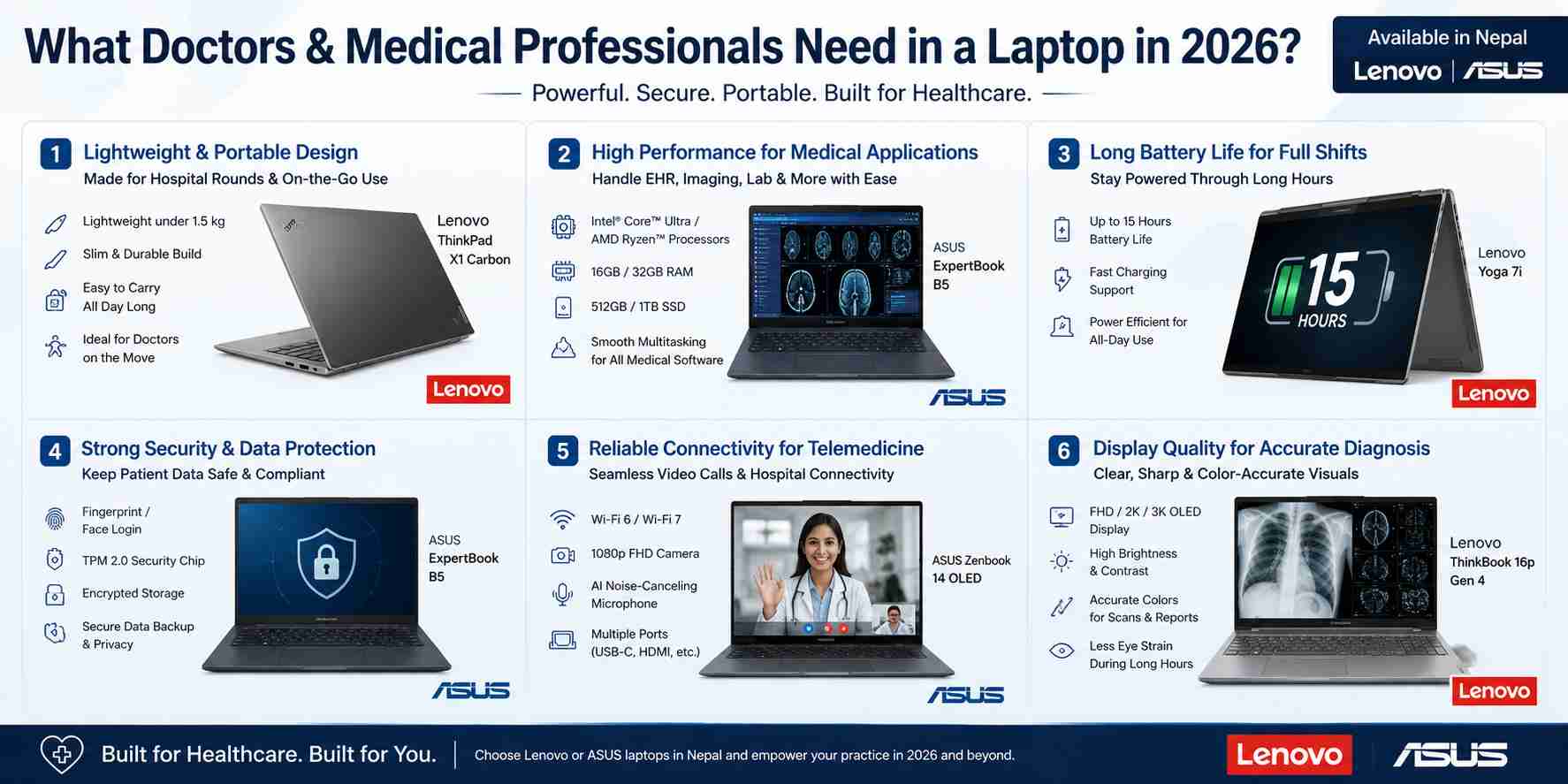
Choosing a laptop for medical use is different from choosing a standard device, as in this industry, efficiency, reliability, and portability are the name of the game. A laptop is required to support a demanding workload every day, whether it's handling patient records, attending appointments via telemedicine, reviewing reports or managing research. This is not the end of the requirements. The following are some of the requirements a laptop must meet to be used by medical professionals and doctors in 2026:
Medical professionals work with several applications at once. Electronic Health Record software, medical imaging, research platforms and video conferencing tools can strain laptops with lower specifications. High-speed processing enables efficient multitasking as well as decreases potential time wastage in hectic routines. Increased speed not only increases productivity but also results in a better experience during patient consultations, collaborations, and documentation.
Adequate quantities of RAM ensure non-stop functionality for the entire day. By 2026, physicians should have laptops with 16GB RAM to quickly switch between different applications as per the requirements of the hospital or medical center.
Doctors who frequently work with radiological software, virtual machines, 3D imaging, large databases, or other software programs that consume a lot of memory may want to install 32GB of RAM on their computers. Enough memory will ensure that the laptop is responsive, even when multitasking.
Doctors and other healthcare workers spend many hours traveling between patient rooms, clinics, hospitals, conferences and conference rooms. Battery life is important because charging points are not always available during busy schedules.
The long battery life on some laptops makes working possible without disruptions on rounds, consultations and during travels. Efficient processors with good battery performance ensure that doctors work without the need to drag their chargers all the time.
Doctors have to move around a lot. It is very tiring to lug along a bulky computer when commuting for long distances or making hospital rounds. The slim form factor is more convenient because of the ease of mobility from one office to another.
Portable computers are also suitable for the frequent traveler. Medical students and physicians who have to travel for research purposes or attend conferences would find a portable and durable computer extremely useful.
There are a number of tasks that health care professionals engage in, such as going through patient files, participating in video conferencing and studying scientific papers. It is important to consider a display that will not strain your eyes.
High resolutions help with legibility, especially in cases where you are dealing with pictures. High brightness levels also contribute to clearer and more pleasant viewing conditions.
One aspect of healthcare that demands attention when choosing laptops is the need to secure patients’ information. In the field of medicine, professionals are required to use laptops that have the highest level of protection when it comes to storing documents and other sensitive files.
Biometrics, such as the presence of biometric readers in laptops (fingerprint scanner, etc.), is important because it enhances the security of the data stored in the computer. Additionally, there are laptops that come with a built-in privacy shutter, a TPM security chip, and encryption capability. Secure devices ensure that the data is well protected from unauthorized access.
In the future, telemedicine will continue to be significant within the health sector by 2026. The provision of a webcam and a quality audio device in the laptop is important for effective telemedicine consultations. High-quality microphones, 1080p webcams and AI noise cancellation improve the clarity of video calls and create better patient interaction. Clear communication is essential during remote consultations and online training sessions.
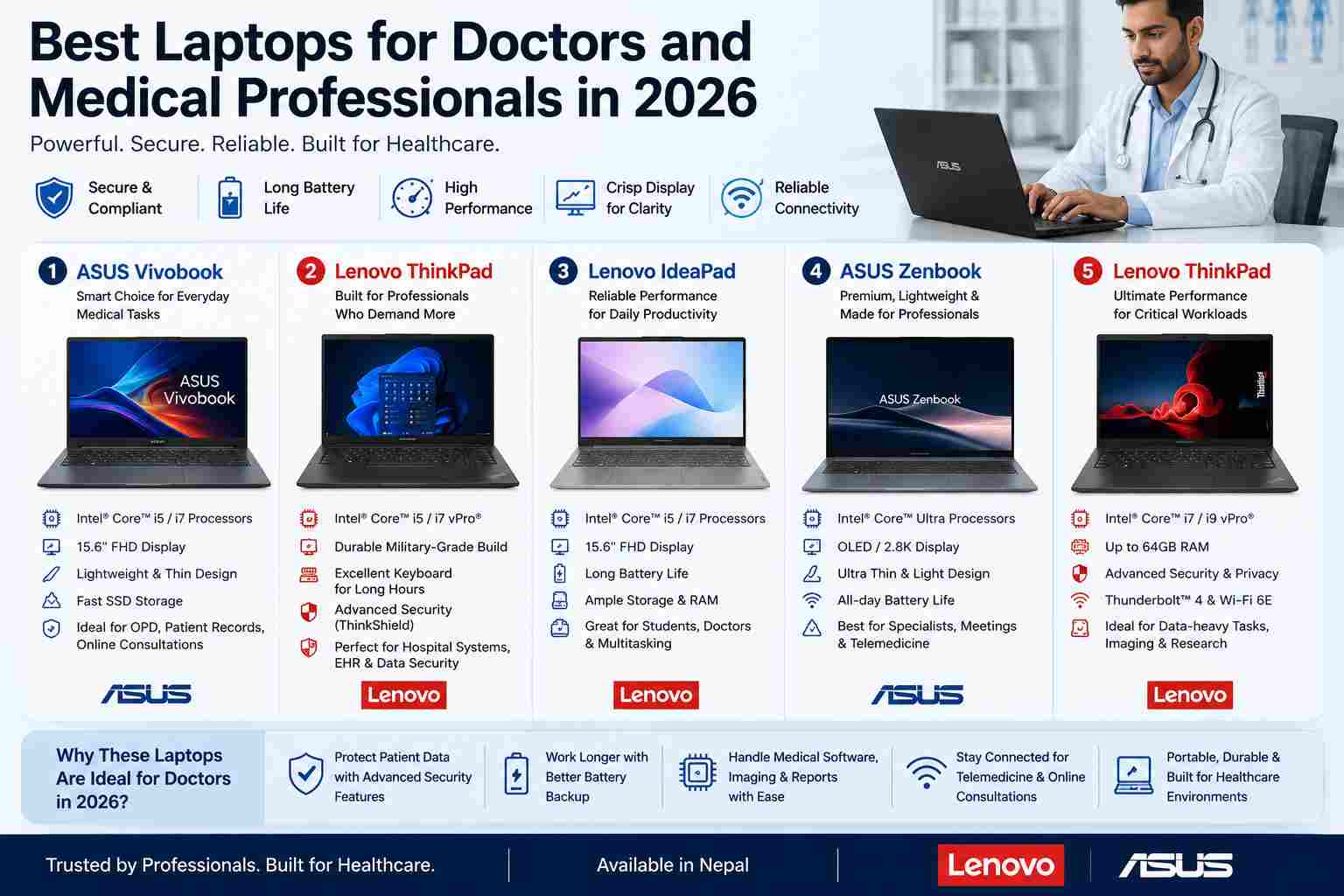
Now there are many laptops that meet the needs as we previously mentioned. Therefore, mentioning each model individually would take a long time. Therefore, we here provide you with some of the best series as a whole that would make for ideal and best laptops for doctors and medical professionals in 2026. These series include:
The Lenovo IdeaPad series is a practical and budget-friendly option for medical students and healthcare professionals who require dependable everyday performance without spending excessively. They efficiently deal with activities that include reading medical PDF documents, taking part in online classes, reading patient documentation, researching medical literature, and taking notes. With the help of such a device, typing becomes much easier and faster during extended work sessions, which would be convenient for completing writing tasks, taking notes, or recording patient information. Additionally, installing an SSD results in quicker booting up and access to relevant literature and applications on the computer. Taking all of these advantages into account, it can be said without any doubt that the Lenovo IdeaPad is still the best choice in 2026.
The Asus Vivobook line comes up with its lightweight nature and fast responsiveness that suits perfectly into the hectic schedule of doctors, physicians, and medical students. The screen gives a comfortable reading experience during long hours of study or working sessions, and the ergonomically designed keyboard assists in reducing strain during prolonged typing and documentation. It is also very easy to transport from hospital to clinic to classroom or library and vice versa, hence making this product line highly portable for professionals always on the move. This product line can be loaded with fast processors and SSD storage, enabling it to multitask across multiple research tools, browser windows, video conferencing, and office programs efficiently.
Among all laptops currently available in the market, ASUS ZenBooks are particularly notable for the quality of their displays, their lightweight nature, and their ability to offer good battery life. This makes these devices ideal for use by health care providers since they need to read documents, go through medical records, and undertake research at length. With their high-resolution screens, they will provide clear images that will help minimize any strain on the eyes. Moreover, ASUS ZenBooks are very quiet and provide efficient multitasking performance. All of these features together provide an excellent user experience while using these laptops online for consultation, documentation, and working collaboratively with other professionals.
The Lenovo ThinkPad lineup from Lenovo has established itself as being robust, having an excellent keyboard and providing business-standard performance; hence, it is ideal for use by doctors. The ThinkPads are capable of performing seamlessly without interruption when it comes to using EHRs, telemedicine software, research applications, and documentation tasks. One of the notable characteristics of the ThinkPads is their keyboard; it is designed to accommodate typing even for extended durations needed during documentation. Additionally, the ThinkPads have added a security layer through fingerprint scanners, TPM security chips, and other privacy measures, which are crucial when handling patient information and records. Combined with their durable build quality, dependable battery life, and professional design, Lenovo ThinkPads continue to be among the most trusted laptop series for long-term medical and healthcare use.
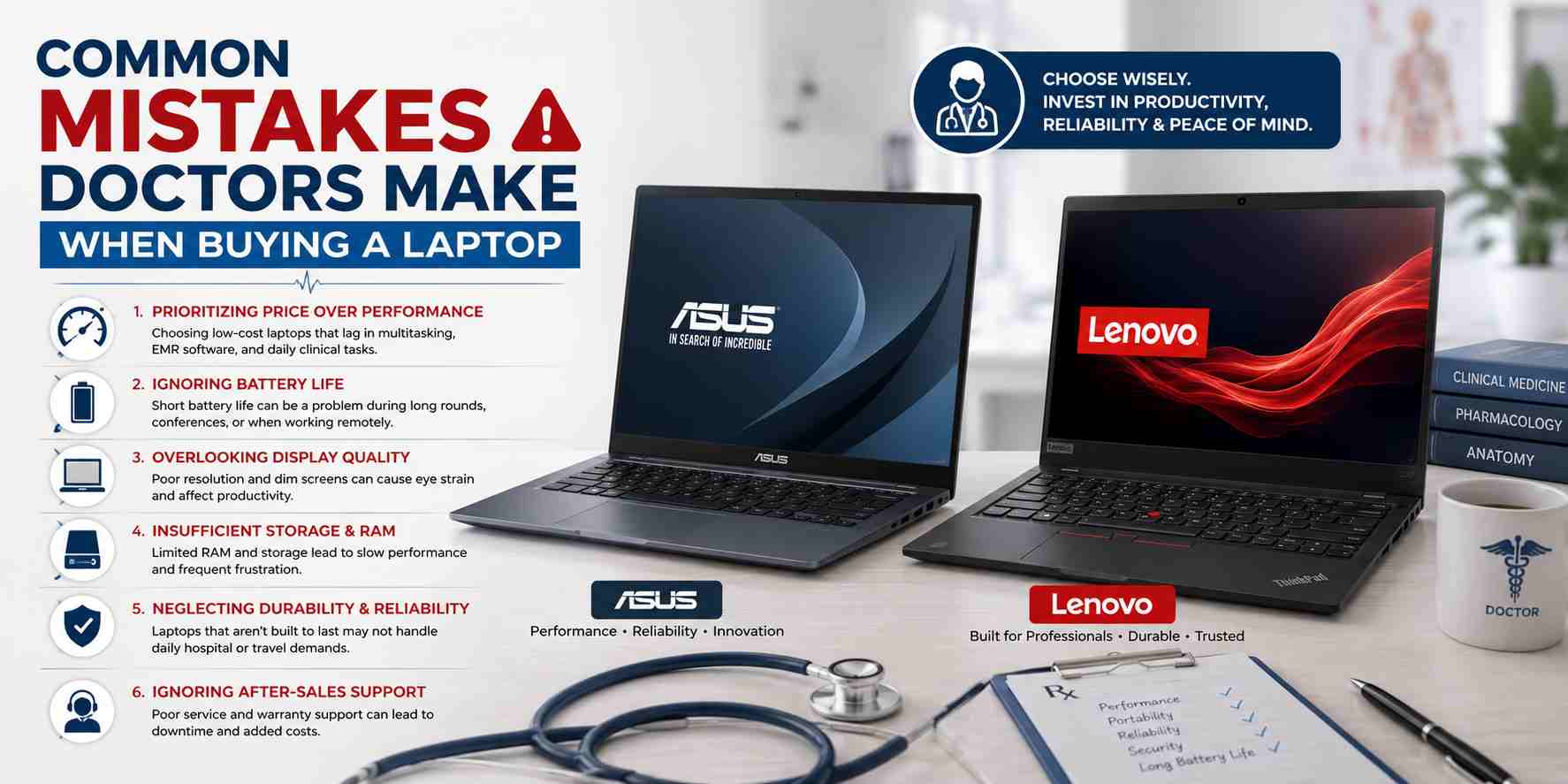
Now, although knowing the series does help, there are still many laptops out there, and it is rather easy to make a mistake. Therefore, many doctors and medical professionals often end up choosing devices that do not match their workflow. This usually leads to performance issues, discomfort during long working hours, or unnecessary upgrades later. These insights about common errors can be useful when choosing a better-performing and more durable laptop in 2026.
Doctors opt for cheap consumer laptops believing that their choice will help them cut costs; however, such laptops are usually poorly suited for extensive multitasking and working on heavy loads, as they provide lower build quality, average performance, and less longevity.
One of the most crucial things about a laptop, especially in the medical field, is the battery backup time since a doctor may find himself or herself far from any charging station while working in a hospital. A poorly backed-up laptop may affect the effectiveness of their work negatively.
Although having 8GB RAM seems to be enough for regular operations, this memory capacity is no longer optimal for doctors in 2026. Working on EHR, conducting research, participating in video conferencing, and using various browsing applications are a must in 2026, so it is crucial to have adequate RAM capacity.
The healthcare sector deals with delicate and private data from patients, yet most consumers fail to prioritize security features while buying a laptop. Insecurity can be posed by non-fingerprint scanners, non-encryption capabilities, and a lack of TPM security modules, among other elements that pose privacy risks.
Consumers tend to believe that any heavy laptop will be effective for different purposes; however, some laptops may be heavy. For doctors who move frequently between departments or carry laptops during rounds, heavy devices quickly become inconvenient and impractical.
The medical field is a highly sensitive sector where every decision can be the difference between a fully healed patient and a delayed treatment. Therefore, it is highly important to choose the right laptop as a doctor or medical professional. Among many laptops available out there, some of the best series include Lenovo IdeaPad, ASUS Vivobook, ASUS Zenbook, and Lenovo ThinkPad. These series of laptops are not only highly reliable, but efficient and secure as well.
Frequently Asked Questions On the Best Laptops for Doctors and Medical Professionals in 2026
There is no universal laptop that suits everyone, but here is a list of the most trusted models, such as Lenovo IdeaPad for those with limited budgetary considerations; ASUS Vivobook for well-balanced work; ASUS Zenbook for professionals who want premium portability; and Lenovo ThinkPad – durable and professional laptops. This list of series assists in performing several activities in the medical field, such as documentation, research, and telemedicine services.
A laptop in 2026 must have at least 16GB RAM, according to the doctor, while in the case of complex research and multitasking, it should have at least 32GB of RAM.
Security matters for doctors because doctors keep confidential and sensitive data about patients in their laptops and should prevent any leaks. Various security features include fingerprint scanners, TPM security chips, encryption software, and privacy shutters.